
This summer marked one of the worst years for Minnesota wildfires in living memory. For days, smoke blanketed much of the state, pushing air quality to the worst recorded levels in Minnesota’s history. The U.S. Forest Service now estimates the fires burned more than 70,000 acres of Minnesota forest this summer. At the center of it all is the Boundary Waters Canoe Area Wilderness (BWCAW), the most visited wilderness area in the country, drawing more than 150,000 visitors a year.
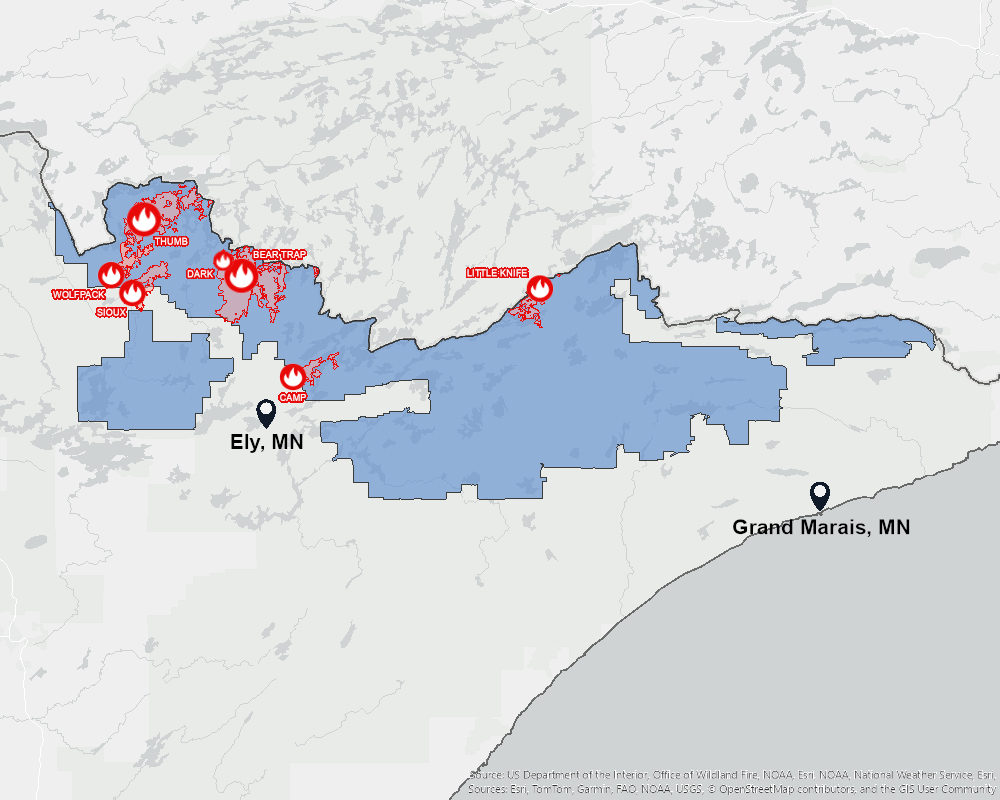
On July 14, the U.S. Forest Service took the rare step of closing the entire wilderness area to the public due to the ongoing fires. It marked only the third full closure in the BWCAW's history, leaving the area completely inaccessible to all visitors for 13 days, until a gradual reopening began on July 27. Initially, some access points were reopened exclusively to day visitors, primarily in the eastern portion of the BWCAW. Overnight visitors were not granted access until July 30 and as of the time of writing, hundreds of campsites and many entry points remain closed (U.S. Forest Service).
For many communities and businesses in the surrounding region, the wildfires have been devastating. These fires unfolded during the peak of Minnesota's summer tourism season spanning from mid-July to late-August. The closure of the BWCAW—combined with weeks of hazardous smoke, national news coverage, and lingering restrictions on campfires and overnight permits—was enough to keep many would-be visitors away, even from areas that were never closed.
The lost visitors to the region would have spent money on hotels, restaurants, souvenir shopping, and more — and their absence has left businesses and communities struggling to recover. For outfitters, guides, resorts, restaurants, and retail shops, a few bad weeks in July can prove devastating, since so much of their annual revenue is earned during the short peak summer window.
This analysis estimates the economic impact the loss of visitors has had on the two largest surrounding communities of Ely and Grand Marais. Tourism represents a significant portion of the economic activity in the region. As the fires forced visitors to cancel trips, millions of dollars in tourism spending were likely lost during the 2026 tourism season. Knowing the magnitude of these economic losses can help policymakers and community leaders as they advocate for targeted economic relief.
Figure 2 shows the daily non-local visitors to Ely, Minnesota during the month of July for the past three years using data from Placer.ai. The visitor data from each year was aligned to the weekdays of the 2026 calendar. The portion of the graph shaded in gray represents the period that the BWCAW was fully closed. Because Placer.ai counts the total number of visitors for each day, visitors who are in the region for multiple days are counted more than once giving us a measure that essentially counts “visitor-days.”
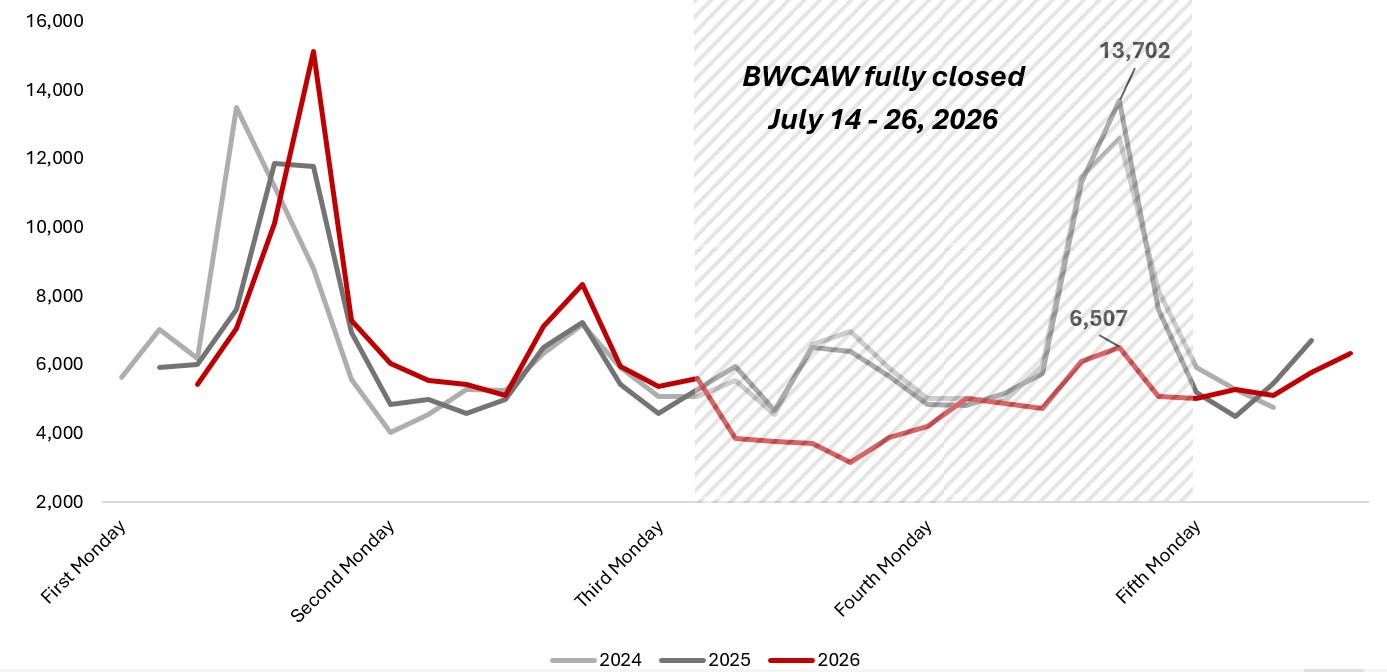
Visitor traffic in Ely closely followed the two-year average for the first half of July 2026, even exceeding previous years’ numbers during the popular Fourth of July weekend and the second weekend of the month. However, after the Boundary Waters closed completely on July 14, visitor numbers fell well below prior years, and the traffic spikes normally seen on the third and fourth weekends of the month were far lower than previous years.
The hazardous air quality also forced the cancellation of the Blueberry Arts Festival (originally scheduled for July 24–26). The festival is one of Ely's largest annual draws, as shown by the spike in the graph. Across the three-day event, the community seems roughly than 30,000–40,000 visitors each year, according to the Ely Chamber of Commerce.
As a result, July 2026 saw 22,070 fewer non-local visitor-days than the previous two years. In 2026, Ely saw only 182,000 total visitor-days — down from the previous two-year average of nearly 204,000.
It should be noted that the remaining visitor numbers for 2026 include hundreds of firefighters, reporters, and people assisting with the evacuation. While these individuals spent money on food and lodging within these communities, they likely did not spend to the same level we would expect from a typical tourist, especially in industries such as shopping, recreation, guides, and outfitters.
Grand Marais saw a similar initial decline in visitors. Figure 3 shows the number of non-local visitor-days to Grand Marais during July from the past three years. During the first half of the month visitor numbers in 2026 were comparable to previous years. Following the spread of fires and the closure of most recreation in the region, the number of visitors dropped sharply. The portion of the graph shaded in gray shows the period when the BWCAW was fully closed to visitors. Because Grand Marais is farther from the epicenter of the fires than Ely, trails nearby were able to open sooner, and many recreation opportunities were less impacted by the fires. By the fourth weekend of the month, visitor numbers had largely returned to previous levels.
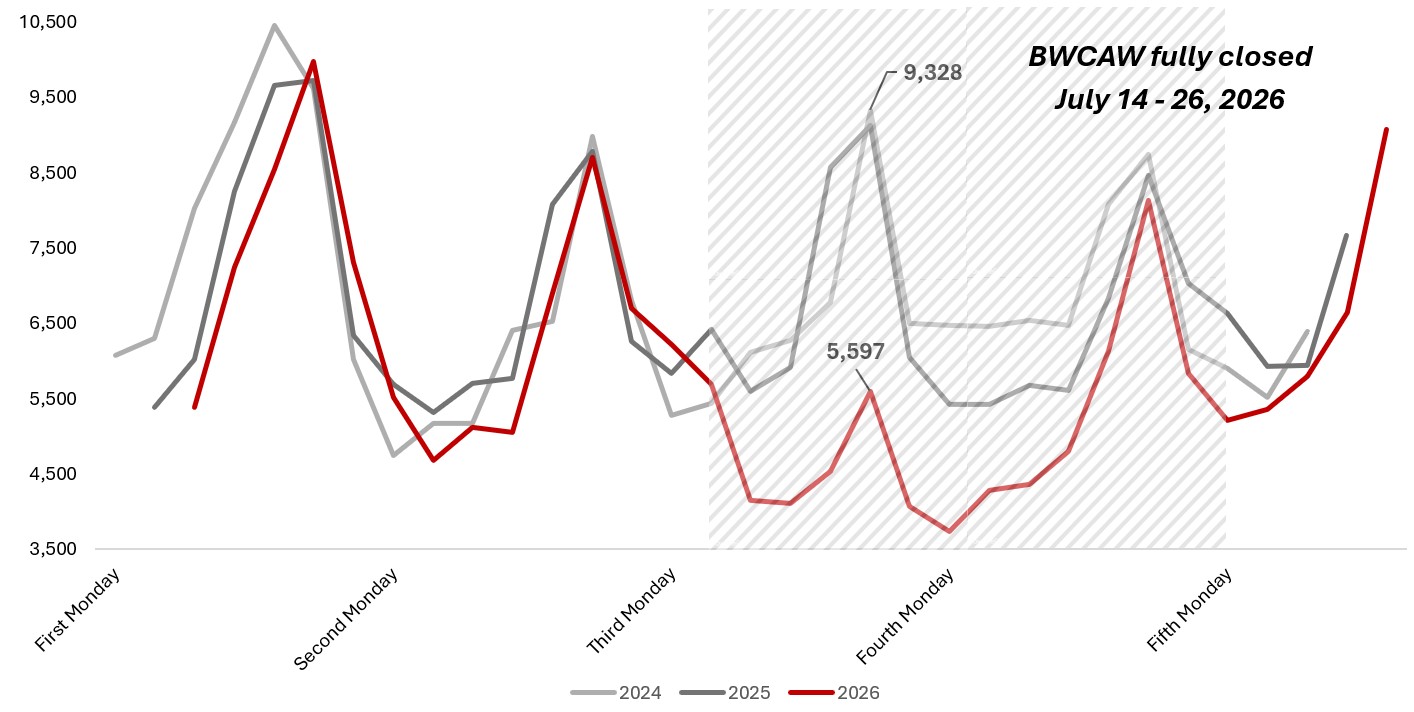
Despite the relatively quick recovery in visitor numbers, Grand Marais recorded 25,647 fewer visitor-days in 2026 compared to the previous two-year average. In 2026, Grand Marais saw only 187,000 visitor-days, significantly fewer than the 212,000 average from July 2024 and 2025.
The lost visitors to Ely and Grand Marais resulted in $4.4 million in lost economic output in Ely and $4.6 million in Grand Marais. Combined, these two communities lost $9.0 million in combined economic activity during the two weeks in July when the Boundary Waters were closed. The total economic output estimates include both direct impacts from the initial spending the visitors would have contributed as well as the indirect and induced economic activity that would have resulted as the initial spending would have rippled throughout the economy. In addition, the economic spending from these visitors would have helped to support approximately 72 jobs. Without this economic activity, many business owners may have had to reduce staffing levels or eliminate jobs entirely due to the lost economic activity.
In total, the communities of Ely and Grand Marais saw roughly 47,000 fewer visitors in July 2026 compared with the previous two years.
These estimates come from the Bureau of Business and Economic Research (BBER), using previous visitor surveys to calculate average spending, and IMPLAN input-output software to model the total economic impact on Ely and Grand Marais. The BBER survey data shows that a typical non-local visitor spends approximately $168 per day in Minnesota. Because the data from Placer.ai counts visitors for each day spent within the region, the difference from the 2026 visitor counts to the previous two-year average was used with the per person per day spending estimates to account for multi-day visits.
Impact | Employment | Labor Income | Value Added | Output |
|---|---|---|---|---|
Ely, MN | 35 | $1.3 | $2.4 | $4.4 |
Grand Marais, MN | 37 | $1.4 | $2.6 | $4.6 |
Total | 72 | $2.7 | $5.0 | $9.0 |
The 2026 closure of the BWCAW, combined with hazardous air quality and the cancellation of major events, resulted in an estimated loss of 47,717 visitor-days to the communities of Grand Marais and Ely in July alone. This loss in visitor spending caused $9.0 million in total lost economic activity and put many jobs in tourism industries at risk. Although the Boundary Waters continue to gradually reopen and visitor numbers have recovered, the loss of this summer's peak season will have lasting impacts on outfitters, guides, resorts, and other tourism-dependent businesses that rely on these few weeks to sustain them through the rest of the year. With hundreds of campsites and many entry points still closed, the full extent of the damage to the communities and their economies may not be known until well after the season ends.
NOTE: This analysis, which focuses solely on non-local visitor trends, was conducted in consultation with UMN Extension Community Development and representatives from the community organization Ely for Ely. A complementary study from UMN Extension is forthcoming; it will utilize surveys of Ely businesses to explore qualitative and business-level impacts across the region.